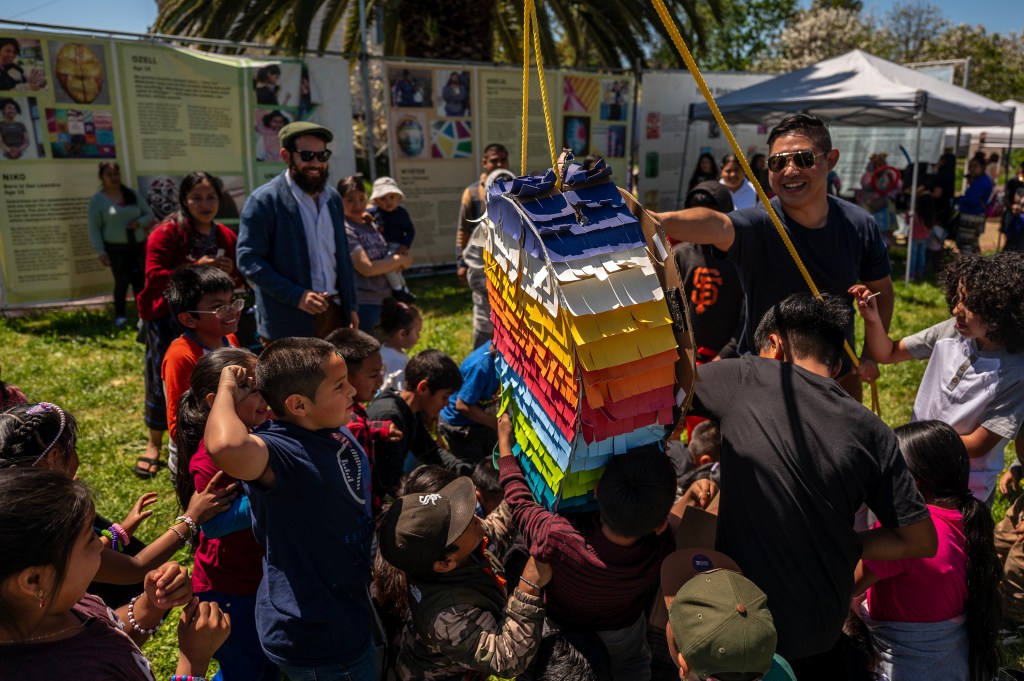


Community participation is the heart of El Tímpano’s work with the Bay Area’s Latino and Mayan immigrants. Over the past year, we’ve expanded our community programming to include civic science.
Scientific research and study have historically been inaccessible to marginalized communities. Science remains an insular field where few efforts are made to make findings easily digestible to non-English speakers. This leaves immigrants in the dark about scientific discoveries that could be relevant to their lives and also discourages people from diverse backgrounds from entering the field.
Civic science is the practice of public participation and engagement in scientific research. Including diverse communities empowers individuals to participate in science and creates a space for learning and discovery for the participants and experts.
El Tímpano has developed three civic science opportunities that align with our mission to inform, engage and amplify the voices of the Bay Area’s Latino and Mayan immigrant communities.
Our key priorities for these projects are to:
- Provide Latino and Mayan immigrants with information and avenues for taking action
- Produce data on health and the environment that addresses gaps in science
- Foster novel partnerships that connect our communities to scientists and researchers.
So far, we’ve hosted a DIY air filter workshop, a workshop on the hazards of lead exposure and documented local wildlife during a bioblitz. We partnered with experts in the field for each of these events, brought Latino and Mam immigrants together and created opportunities for active participation. Throughout the process, we’ve gained invaluable insight into our communities’ access to nature and their deep care and worry for the wellbeing of their children and families. We’ve also seen how we, as a civic media organization, can improve access to science, nature and tools for scientific discovery.
Wildfire season air filter workshop

In the late summer of 2023, during California’s wildfire season, we organized a workshop for our communities to teach them how to create their own air purifier to protect themselves and their families from smokey air. The workshop was conducted in partnership with Common Humanity Collective (CHC), a mutual aid group that designs DIY air filters and distributes PPE to low-income communities around the Bay Area. The idea for the workshop came from El Tímpano’s SMS subscribers, who informed us that smokey air was a major concern. Many community members shared that it triggered their asthma, and asked what more they could do to protect themselves and their families from the dangers of wildfire smoke.
We invited our SMS subscribers, library goers and other East Oakland residents to attend the workshop at the Cesar Chavez Branch Library in Fruitvale. Oakland’s Emergency Management Team also attended to discuss emergency preparedness and the dangers of wildfire smoke. El Tímpano provided live Spanish-language interpretation, written materials in Spanish and on-site childcare. The result was an intimate, engaging and accessible workshop for attendees.
Lead workshop

Our second civic science project was in collaboration with our newsroom’s year-long investigation of Oakland’s ongoing battle with lead-based paint found in housing. According to reports, 83% of Oakland’s rental housing may contain lead, and renters in East and West Oakland are most at risk. Support from the Pulitzer Center allowed us to create an educational workshop about the dangers of lead and how people can protect themselves.
We partnered with the Lawrence Hall of Science’s East Bay Academy for Young Scientists (EBAYS) to facilitate the workshop and offer participants free lead testing of soil samples they brought from home with an XRF machine. EBAYS was an ideal partner, as they conduct civic science curricula in schools across the Bay Area and are experts in making science accessible. We invited the community via SMS, social media and fliers. We also invited La Clinica de la Raza’s promotoras to offer additional resources for participants and tips on how to advocate to their doctors to test themselves and their children for lead.
The workshop, held at the Peralta Hacienda Historical Park in Fruitvale, welcomed Latino and Mayan immigrants to an interactive presentation on the dangers of lead contamination and to give them insight into the newsroom’s investigation. Much like the air filter workshop, we ensured language accessibility by providing live Spanish interpretation, written materials in Spanish and childcare. For El Timpano’s reporters, the workshop helped them connect directly with community members and learn about their awareness of lead hazards. In addition, the workshop aided reporters in finding leads for their reporting.
Bioblitz at Sausal Creek

The latest civic science project we organized—in partnership with the publication, Bay Nature—was a bioblitz designed to gather nature lovers for a few hours to observe as many species as possible within a designated area. Using an app like iNaturalist to document the findings, such events around the country and world collectively help the scientific community and public at large to track ecological diversity. Bay Nature organizes bioblitzes around the Bay Area with its readers, and our goal in partnering with them was not only to document species but also to invite Latino and Mayan immigrants to spend a day in nature with their families and learn more about their natural surroundings.
We chose Sausal Creek as it is close to East Oakland’s Fruitvale District and flows through Dimond Park, a sprawling park with hiking trails alongside the creek.
We worked closely with Bay Nature to ensure all materials about the bioblitz and Sausal Creek were available in Spanish and had El Tímpano staff accompany arriving families to the trail to give them a brief orientation. Families, couples, friends and individuals were encouraged to take as many photos of species as possible and use Bay Nature’s binoculars to capture birds high up in trees. El Tímpano participants identified 213 species and took over 454 photos.
The result was a beautiful outing for our community. One family remarked that they were very familiar with Sausal Creek because it is where they forage for wild mint that they use for tea. Another participant said she was happy to learn about Dimond Park for the first time. “I plan to return again to the park to walk, or invite friends so that they get to know the park too,” she said.
What we learned
We learned that interactive activities bring about curiosity, engagement and shareable knowledge in a way that is not always possible through traditional reporting. For the lead workshop, for instance, participants learned the lead levels of their soil sample right there and then, opening up conversations between participants about the urgency of the matter.
Another major takeaway from the lead workshop was the desire of local experts and institutions to engage with Latino and Mayan communities. For each of the three projects, this was the first time our partners had conducted such an event in Spanish to reach non-English-speaking communities. More often than not, language had posed a huge barrier.
Through our three engagements we learned that science can be fun and engaging for everyone—children, families and adults alike. During the air filter workshop, one participant noted with glee that they hadn’t done anything hands on since they were in grade school. They enjoyed the workshop’s participatory experience, which we aspire to bring into every component of our civic science programming. During the bioblitz, kids spearheaded the trails with their parents close by; they picked up acorns and patiently waited for their parents to snap a photo.
The future of civic science at El Tímpano
As our civic science work continues, we are excited to offer more opportunities to bring Latino and Mayan immigrants together to explore, be curious and contribute to scientific findings. There is deep knowledge to be gained by actively involving communities in science and there is much for us to learn from each other.
If you are interested in partnering with El Tímpano to involve Latino and Mayan immigrants in civic science programming, we want to hear from you! You can send an email to msierra@eltimpano.org.


